



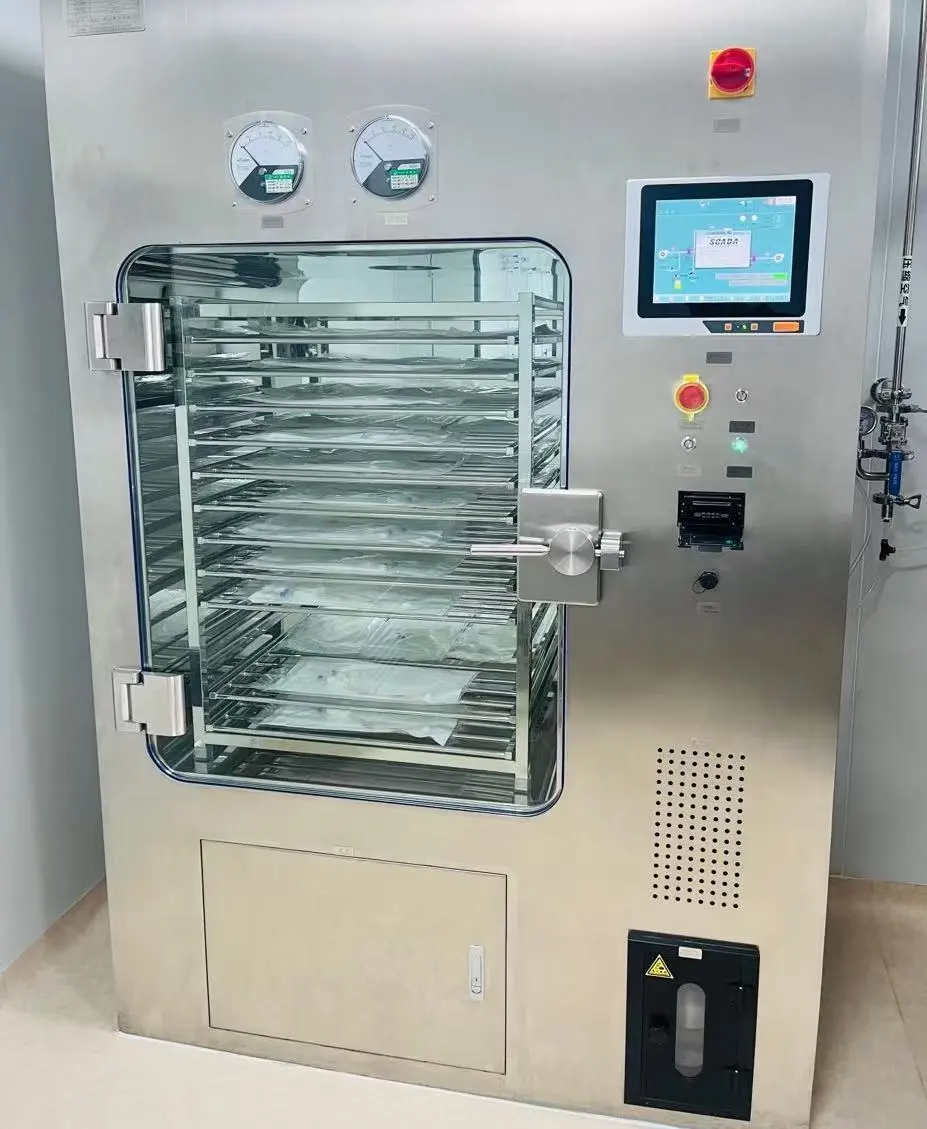
Vhp Pass Box Car-T Cell Culture Laboratory Gmp Certification
Core Working Principle
The core principle relies on the strong bactericidal properties of VHP to achieve low-temperature sterilization. The overall process consists of several key stages. First, a dehumidification process reduces the humidity inside the chamber, creating optimal conditions for VHP sterilization. Next, the VHP generator heats and vaporizes a food-grade hydrogen peroxide solution, sending the hydrogen peroxide vapor into the chamber and rapidly increasing its concentration. The vapor effectively kills bacteria, viruses, fungi, and spores. After sterilization, a residue removal system reduces the residual hydrogen peroxide in the chamber to below 1 ppm, ensuring operational safety and the safety of subsequent items. Simultaneously, the equipment is equipped with a double-door interlocking device to prevent both doors from opening simultaneously, thus preventing cross-contamination caused by air convection between different clean areas.
Main Structural Configuration
The equipment's structural design revolves around sterilization and cleanliness requirements. Internally, it primarily uses 316L stainless steel, while externally, it utilizes 304 stainless steel, ensuring corrosion resistance and ease of cleaning. Common configurations include a VHP-specific generator, H14-grade HEPA filters, a sterile air supply system, an electromagnetic door interlock system, and a sterilization residue removal system. Some high-end models also feature a Siemens PLC control system and a touchscreen human-machine interface, supporting automatic or manual operation. They can monitor parameters such as temperature, humidity, and pressure, and some models also include alarm functions.