



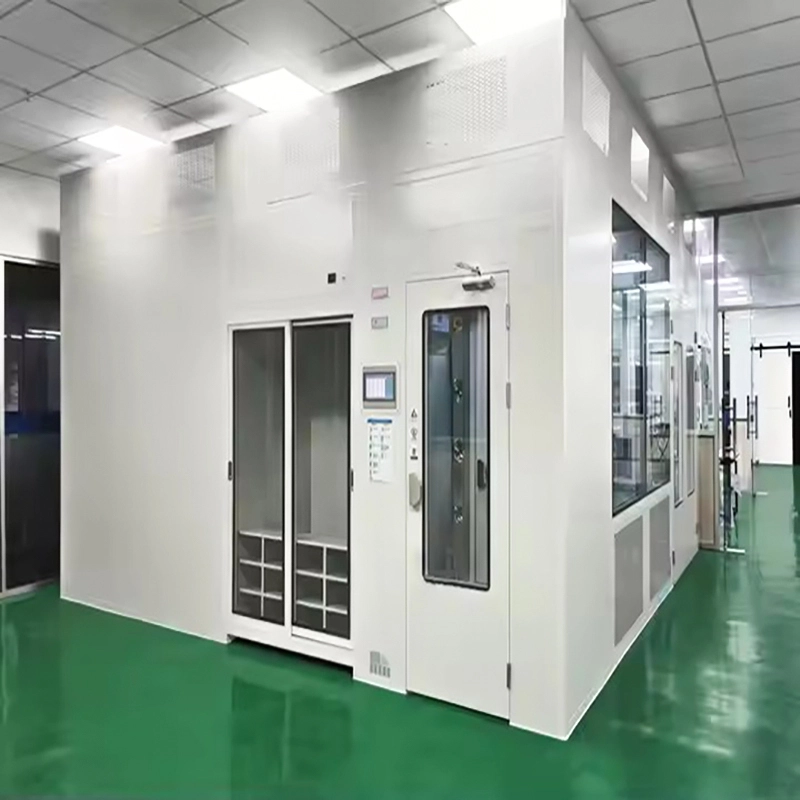
ISO 7 modular cleanroom for medical devices and food processing
Product Specification
| Speed (m/s) |
0.45m/s ±20% |
| Temperature(optional) | 18-28°C |
| Humidity(opiional) | 45-65% |
| Illumination | 300-1000LUX |
| Ceiling Material | Sandwich color steel plate |
| HEPA Filter | 99.99%@0.3um |
| Voltage | 220V Electrical Equipment, 380 V |
| frame | Steel cube with baked enamel |
| Certification | Rohs/CE |
| After Warranty Service | Video technical support/Online support |
Core Technical Parameters
1. Cleanliness Indicators
Except for ≥0.5μm particles ≤352,000/m³, ≥1μm particles ≤83,200/m³, and ≥5μm particles ≤2,930/m³; during static testing, the indoor particle concentration must consistently meet the standards. During dynamic production, cleanliness levels can be maintained through reasonable personnel and equipment management.
2. Airflow and Ventilation Design
Non-unidirectional (turbulent) airflow organization is primarily adopted, combined with a top-mounted high-efficiency particulate air (HEPA) filter for air supply and a side-down return air layout; the air exchange rate is 30-60 times/hour, which can be adjusted according to specific production needs to balance cleanliness and energy consumption.
3. Temperature, Humidity, and Pressure Differential Control
● Temperature is controlled at 20-26℃, and humidity at 40-60%RH, suitable for processes such as medical device assembly and food baking/packaging.
● The pressure differential between clean and non-clean areas is ≥5Pa to prevent the infiltration of external contaminants; stepped pressure differentials are set between different functions to avoid cross-contamination.
Modular Structure Advantages:
1. Rapid Deployment: Wall panels, ceiling panels, and flooring are prefabricated in the factory, using snap-fit or bolt connections. On-site assembly time is reduced by more than 50% compared to traditional cleanrooms, making it suitable for rapid capacity expansion by medical device companies and production line upgrades in food factories.
2. Flexible Expansion: The number of modules can be increased or decreased according to production capacity changes, or the internal layout can be adjusted (e.g., adding isolated operating rooms or material transfer areas). After disassembly, it can be reassembled at a different location, resulting in high reusability and reducing long-term operating costs for enterprises.
3. Material Compliance:
● Wall panels use color-coated steel sandwich panels (fireproof Class A) or antibacterial color-coated steel panels, with a smooth and easy-to-clean surface, meeting the GMP requirements for medical devices and the HACCP certification requirements for food production.
● Floors use epoxy self-leveling flooring or PVC roll materials, which are wear-resistant and corrosion-resistant, able to withstand acid and alkali cleaning in food processing or the impact of equipment movement in medical device production.
Industry Application Scenarios
● Medical Device Industry: Applicable to the production of medical dressings, assembly of in vitro diagnostic reagents, and packaging after cleaning and sterilization of surgical instruments. It meets the clean environment requirements of the "Good Manufacturing Practice for Medical Devices" and effectively reduces the risk of microbial contamination.
● Food Processing Industry: Can be used in scenarios such as cooling baked goods, packaging ready-to-eat foods, and filling health supplement powders. It inhibits bacterial growth and extends the shelf life of food; at the same time, it reduces the introduction of foreign matter such as dust and hair during the production process, improving food safety.
Commonly used equipment in cleanrooms