



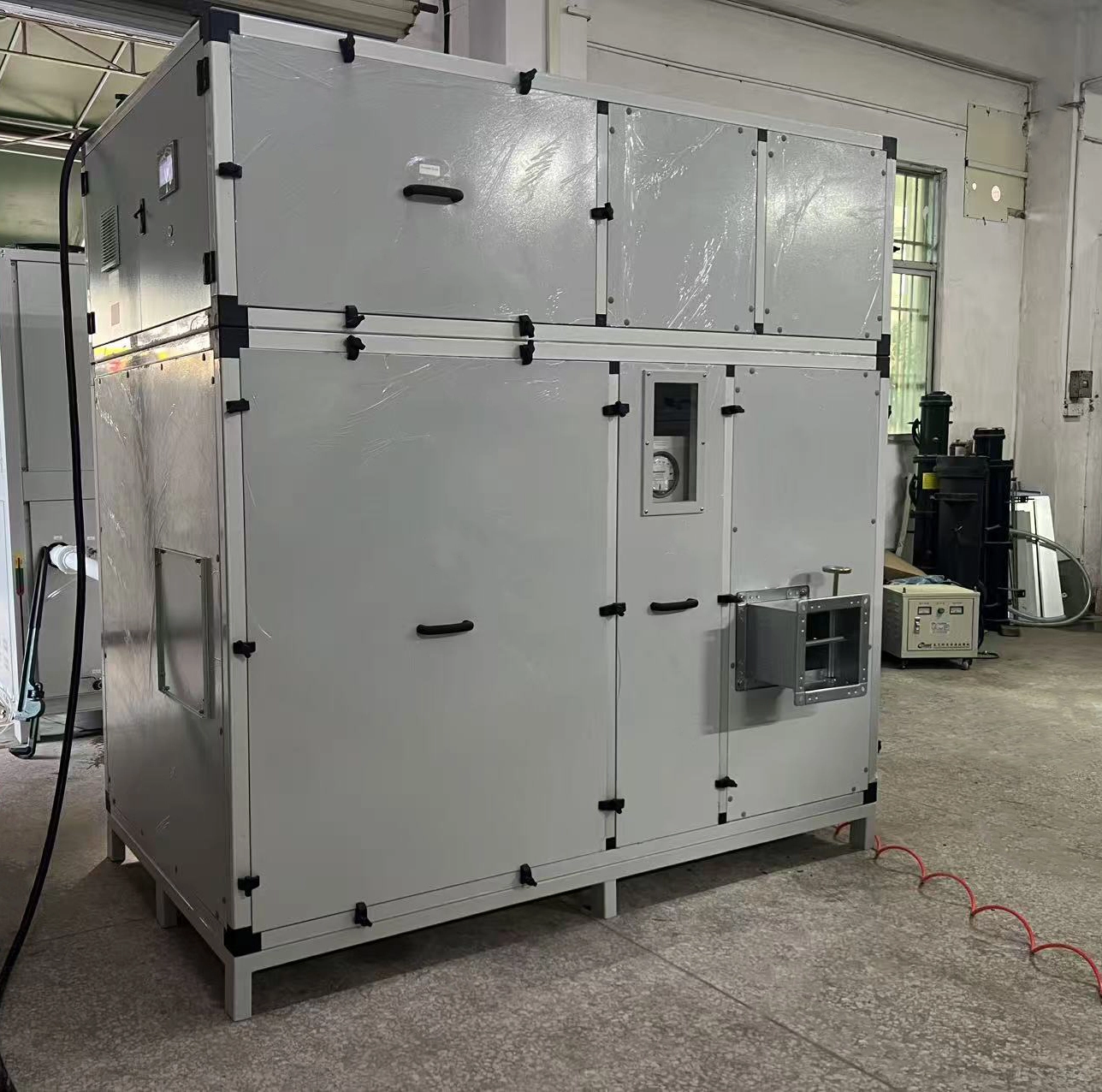
Rotary dehumidifier
Product feature
The core component of a rotary dehumidifier is a honeycomb-shaped rotor, composed of a special ceramic fiber carrier and activated silica gel. The rotor is divided into two zones by a specially designed sealing device: a treatment zone and a regeneration zone. When humid air needs dehumidification, it passes through the treatment zone, where the water vapor is adsorbed by the activated silica gel. Dry air is then delivered to the desired space by a fan. Meanwhile, the slowly rotating rotor, carrying nearly saturated water vapor, enters the regeneration zone. In the regeneration zone, high-temperature air blown in the opposite direction desorbs the adsorbed water from the rotor, which is then expelled outdoors by the fan, restoring the rotor's moisture absorption capacity and completing the regeneration process. This continuous rotation of the rotor ensures a stable and continuous dehumidification process.
Water molecules in the air are absorbed by the hydrophilic groups in the silica gel micropores. Additionally, condensation within the capillary structure of the micropores also absorbs a large amount of water molecules.
Heated air enters the regeneration zone, raising its temperature. This activates the water molecules adsorbed in the micropores, weakening their adsorption capacity, and causing them to escape from the silica gel micropores.