



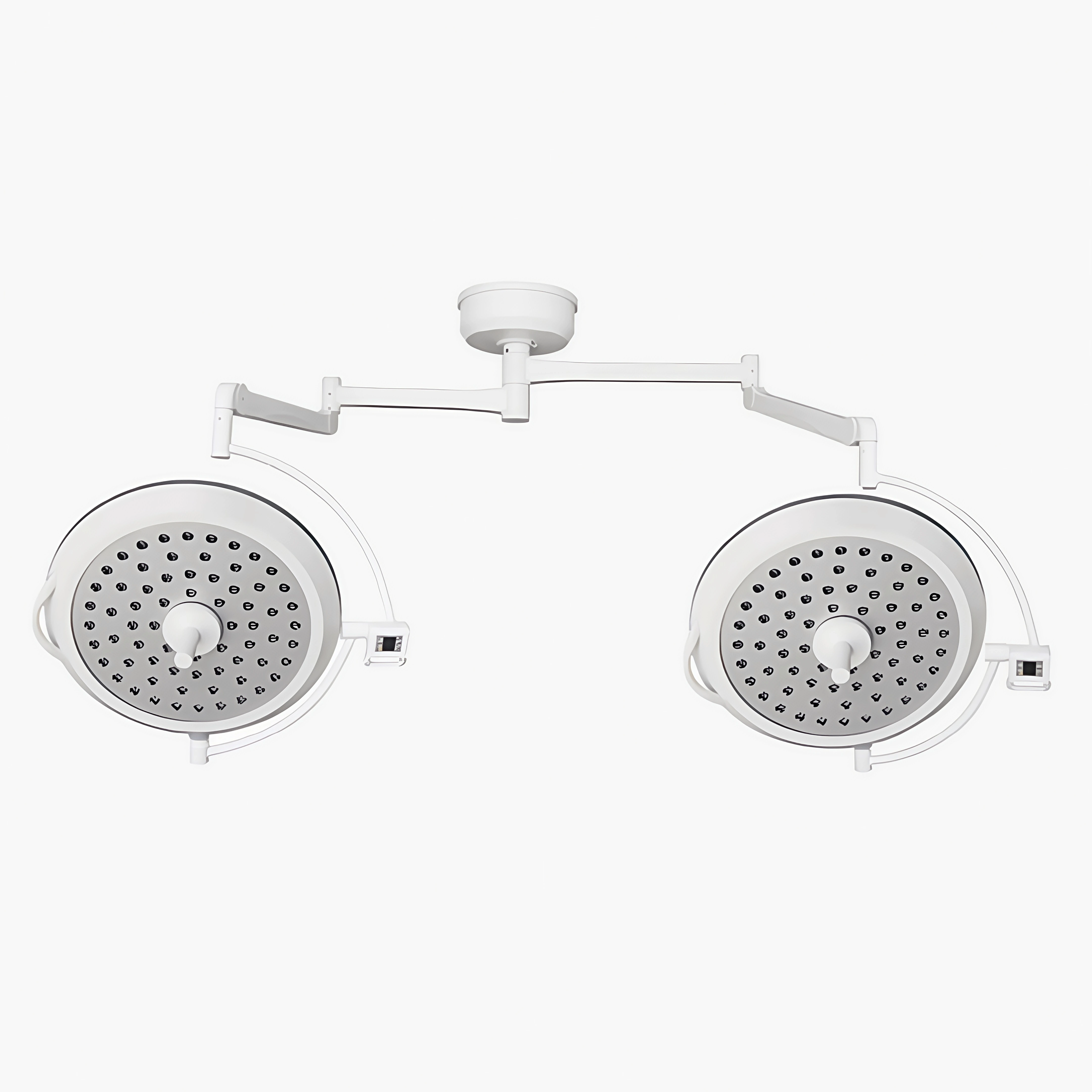
Operating room shadowless lamp
| Size | LED700/500 |
| Flare index | 160-280mm |
| luminance depth(mm) | >1200mm |
| Lux Colour temperiature(k) | 3700K-5000K |
| Colour reduction index(Ra) | 85-98 |
| LED Service life of illuminant | ≥80,000h |
| Power voltage | AC100-240V 50/60Hz |
| LED700 40,000Lux-180,000Lux | LED500 30,000Lux-160,000Lux |
●Structure and Principle:
Structure: Multiple (or groups of) high-brightness bulbs or LEDs are typically arranged in a circle on a lamp panel to form a large-area light source, fixed to a cantilever arm for vertical or horizontal movement. The fixing device can be installed on a fixed point on the ceiling or wall, or on a track in the ceiling. Sterilizable handles or sterile clamps are used for flexible positioning, and automatic braking and stopping functions are included.
Principle: Based on the rectilinear propagation of light and the multi-point light source effect. When light shines on an opaque object, a shadow is formed. Shadowless lamps, by arranging multiple light sources on the lamp panel and illuminating the surgical area from different angles, completely weaken the umbra of the object, producing a shadowless effect.
●Features: High brightness, high saturation, good stability, and strong controllability. It provides ample, bright light with high color saturation, realistic color reproduction close to natural light, and maintains stable illumination during prolonged surgery. The light intensity and color temperature can be flexibly adjusted according to surgical needs.
●Applications: Suitable for almost all surgeries, except for intraductal lighting, such as in the esophagus, trachea, and bile ducts, providing great convenience, especially for delicate and deep surgeries. In addition, it is also suitable for ophthalmic examinations, dental treatments, and other procedures requiring clear, shadowless illumination.